
Updated · 5 min read
Preparing for the SUNY Downstate College of Medicine interview
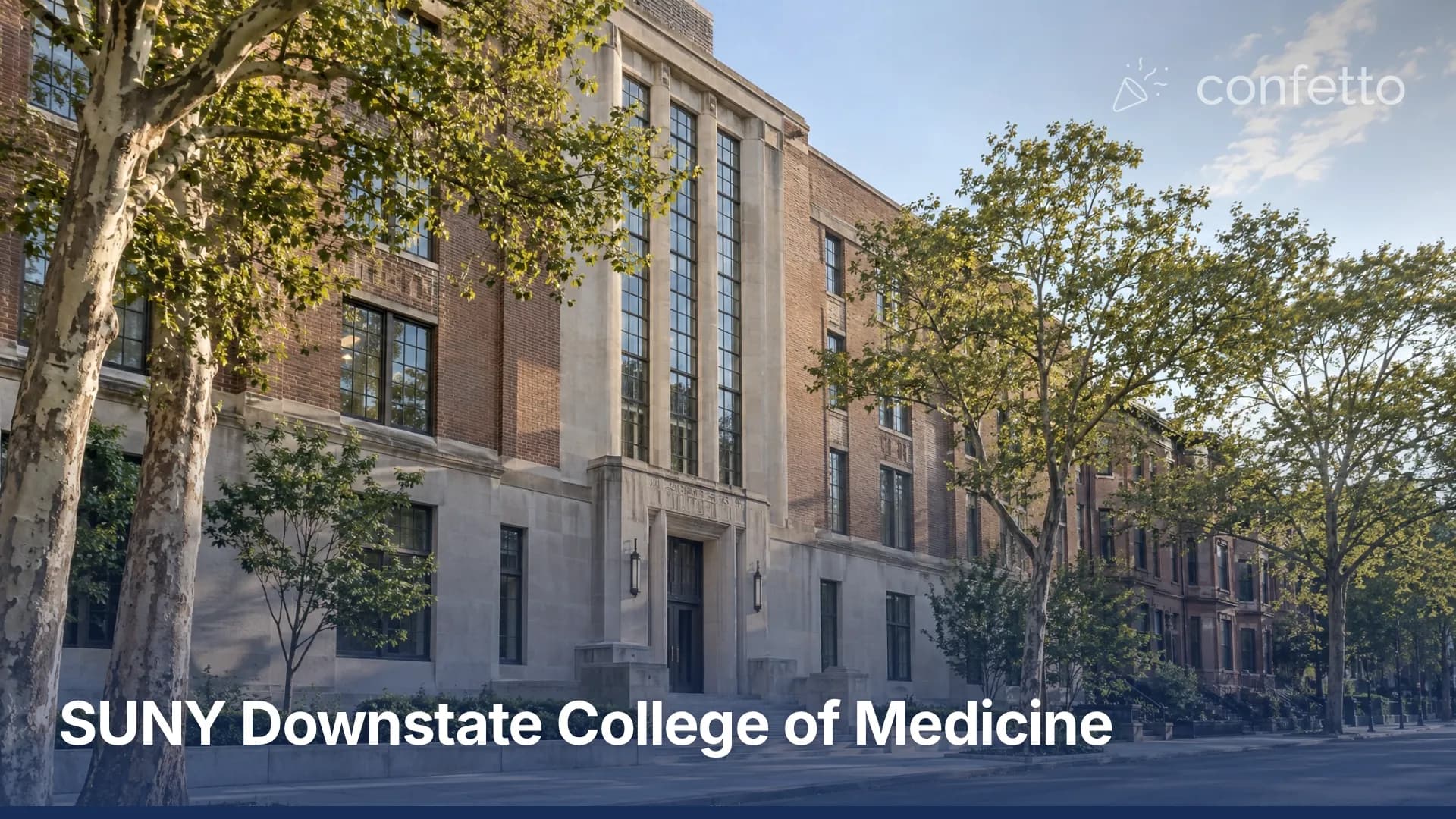
Downstate admissions in brief
SUNY Downstate enrolls about 200 new students each fall. AAMC counts 7,490 applications and 197 new students for fall 2025 entry, about 2.6 per 100. Go by that count, since the pool of about 5,500 on Downstate's admissions page has no year. Downstate publishes no average MCAT or GPA and doesn't mention Casper or PREview. For 2027 entry, AMCAS is due December 1, 2026 and the complete file, including the $100 secondary, by noon on January 4, 2027.
SUNY Downstate College of Medicine holds virtual MD interviews Mondays through Thursdays from after Labor Day into early spring. According to SUNY Downstate Admissions, the school enrolls 200 medical students from approximately 5,500 applicants and begins regular decisions in February. Interview season also includes email-invited virtual chat sessions with enrolled medical students and optional campus tours from September through April. Sources: SUNY Downstate College of Medicine: Application Review, SUNY Downstate College of Medicine: Application Procedures and Deadlines, SUNY Downstate College of Medicine: Admissions FAQ. Last checked November 17, 2026.
SUNY Downstate MD interview format and schedule
This guide covers interviews for SUNY Downstate College of Medicine in Brooklyn, including the MD, combined MD/PhD, and combined MD/MPH pathways. Separate programs in the School of Health Professions, such as Physician Assistant or Physical Therapy, run distinct admissions processes.
According to the SUNY Downstate Application Review page, virtual interviews begin after Labor Day and continue into the first half of spring. Admissions staff schedule interview days Mondays through Thursdays and send invitations to the email address listed on your AMCAS application.
Applications are not reviewed in completion order, so wait times vary widely. Check your spam filter for messages from the admissions office and monitor the Status section of your Admissions Portal.
In the AAMC Medical School Applicant Interview Preparation Guide, schools interview a selected applicant subset to evaluate readiness and mission alignment. AAMC Ask the Experts notes that medical school interviews typically run one-on-one for 30, 45, or 60 minutes with faculty, administrators, or students.
When an interviewer has open-file access to your application, expect direct questions about your coursework, clinical exposure, and service hours. Confirm your exact login link, session count, and daily schedule in your official SUNY Downstate invitation email.
| Interview element | Official SUNY Downstate detail |
|---|---|
| Interview modality | Conducted virtually from after Labor Day into the first half of spring |
| Interview days | Mondays through Thursdays |
| Invitation delivery | Sent by email to the address on file with AMCAS |
| Current student sessions | Virtual chat sessions with enrolled medical students offered via email invite |
| Campus tours | Offered from September to April via email invitation |
| First regular MD decisions | Rendered starting in early to mid-February, typically 8 to 12 weeks post-interview |
Student chat sessions, campus tours, and student input
Throughout interview season, SUNY Downstate emails invitations for virtual chats with enrolled medical students alongside optional tours from September to April. These sessions help you explore clinical training in Central Brooklyn and campus facilities like the Center for Healthcare Simulation.
Treat every interaction with medical students, staff, and faculty with complete professionalism from the moment you join. Former admissions dean Norma Wagoner cautions in AAMC guidance that medical student impressions carry substantial weight with an admissions committee.
Assistant dean Filomeno Maldonado adds that applicants remain under observation throughout every interaction with a medical school. Log in early, stay engaged until the session ends, and bring brief written notes with thoughtful questions.
- Ask enrolled students how early clinical experiences at University Hospital at Downstate build comfort working across languages and cultures.
- Ask how students join Brooklyn outreach programs or initiatives linked to the Arthur Ashe Institute for Urban Health.
- Ask how faculty mentors help medical students launch research focused on local and global health care disparities.
- Ask students which academic support tools and wellness habits helped them adjust fastest during first year in Brooklyn.
- Ask faculty interviewers what qualities distinguish Downstate students who excel during third-year clerkships.
Class profile, New York residency preference, and selectivity
Downstate notes on its Admissions overview page that it trains more New York City physicians than any other medical school. Every fall, the college welcomes an entering class of 200 medical students from a pool of approximately 5,500 applicants.
By our calculation from SUNY Downstate Admissions figures, 5,500 applicants for 200 seats equals 27.5 applicants per spot, or 3.64 percent overall. Reaching the interview stage means you have already cleared a selective holistic review of academics, MCAT performance, character, and service.
According to the SUNY Downstate Class Profile page, the 2026 entering class had a mean age of 24 across 78 undergraduate colleges. That class was 52 percent male and 46 percent female, welcoming traditional, second-career, post-baccalaureate, and non-traditional students.
Downstate Admissions Policies give preference to U.S. citizens and permanent residents who are New York State residents. Qualified out-of-state applicants are also accepted, with 17 states and territories represented in the August 2026 entering class.
International applications, including Canadian citizens, are reviewed only after U.S. citizens and permanent residents.
Downstate reports that its entering mean MCAT and GPA sit slightly above the national admitted average. You can review school-level application counts in Table A-1 and national matriculant benchmarks in Table A-16 of the AAMC 2025 FACTS report.
If you apply from out of state, prepare a specific explanation for why you want to train in Brooklyn. Bursar rates list full-time tuition at $23,235 per semester for New York residents and $36,665 per semester for non-residents.
SUNY Downstate Financial Aid lists four-year tuition and fees at $189,138 in-state and $296,578 out-of-state. By our calculation from SUNY Downstate Financial Aid figures, non-resident tuition and fees total $107,440 more over four years before living costs.
Mission fit: Brooklyn communities, health equity, and PRIDE values
On its Mission, Vision, and Values page, SUNY Downstate Health Sciences University identifies itself as Brooklyn's Academic Medical Center. Its university mission commits to improving the lives of globally diverse communities in an environment that embraces cultural diversity.
The College of Medicine Institutional Mission Statement outlines a four-fold mission covering culturally responsive education, disparity research, equitable patient-family care, and community partnerships. Downstate also emphasizes PRIDE values: pride in daily work, professionalism, respect, innovation, diversity and inclusivity, and excellence.
Connect these priorities to real work on your AMCAS Experience List rather than repeating website phrases. On its Admissions Requirements page, Downstate specifically seeks both medical clinical service and non-medical social service outreach.
- Culturally responsive clinical care: Share a moment where you used an interpreter, adapted communication, or respected a family's cultural health beliefs.
- Non-medical community outreach: Highlight sustained service in tutoring, food access, or housing support that showed you practical barriers to health.
- Health equity and cost awareness: Reflect on how transit gaps, shift work, or medication costs affected people you served.
- Respect and professionalism under pressure: Prepare an example of valuing a colleague's or patient's view during a stressful disagreement.
SUNY Downstate interview questions and how to answer them
The AAMC Preparing for Medical School Interviews guide highlights two core questions to expect: why medicine, and why this school. Prepare for behavioral prompts, ethical scenarios, and direct questions about your academic record as well.
If an open-file interviewer probes a low prerequisite grade, explain the workload or personal circumstances honestly without making excuses. Take full responsibility and point to the concrete study or scheduling change that resolved the problem.
For ethical questions, present balanced reasoning rather than rigid personal declarations. Weigh competing perspectives, keep your primary professional duty focused on the patient's needs, and communicate respectfully.
AAMC guidelines also protect you from unfair or discriminatory questions about age, race, religion, sexual orientation, marital status, family plans, or disabilities. If an inappropriate question occurs, report the interviewer's name and question confidentially to an admissions officer within 24 hours.
Our team wrote the Downstate-focused prompts below from the College of Medicine mission and AAMC interview guidance. Rehearsing spoken responses with traditional mock interviews keeps your answers near two minutes, and you can study extra frameworks in our practice questions with answers.
- Why do you want to become a physician, and which personal experiences confirmed that choice?
- Why do you want to attend SUNY Downstate College of Medicine and train in Brooklyn?
- Tell me about a non-medical community service commitment on your file and what it taught you about structural barriers.
- Describe a time you worked with someone from a different cultural or language background. How did you build trust?
- Looking at your transcript, tell me about an academic setback you faced and what you changed afterward.
- A clinic patient misses follow-up visits for a chronic illness due to shift work and caregiving. How do you respond?
- How should a physician handle a clinical situation where a patient's request conflicts with the physician's personal beliefs?
- Tell me about a time you showed professionalism and respect during a disagreement on a clinical, research, or volunteer team.
Post-interview timeline: February decisions, Hold list, and Alternate list
SUNY Downstate uses a modified rolling admissions process rather than releasing regular MD acceptances in late fall. Status updates generally arrive by email 8 to 12 weeks after your interview, with longer waits around winter holidays.
According to Application Procedures, regular acceptance notifications begin in early to mid-February 2027 and continue until the class fills. Official status notifications go in writing to your AMCAS address, and candidates interviewed from mid-January through April 2027 receive late spring decisions.
Many interviewed applicants receive a post-interview Hold notice before spring waitlist decisions. Downstate clarifies that a post-interview Hold is not the Alternate list, which forms in April from eligible Hold candidates.
Track reply windows carefully once offers arrive. Accepted applicants initially have 14 calendar days to reply, tightening to 5 business days on May 1 and 2 business days in July, while Alternate list invitees get 5 business days.
| Portal or email status | Stage of cycle | What SUNY Downstate does next |
|---|---|---|
| Hold for fall grades | Before interview | Committee re-reviews your file after you upload your fall grade report PDF in the portal |
| Hold for spring consideration | Before interview | Committee re-reviews your application for potential interview consideration after January 2 |
| On hold after interview | After interview | Keeps you under active consideration for Alternate list placement in April |
| Alternate list | Established in April | Gives you 5 business days to accept a spot, with offers sent from April through summer |
Application deadlines, portal updates, and 7-day prep checklist
Show details
Downstate's AMCAS page recommends submitting your primary application before September 1, and completing your full file before October 1. All required items must be on file by 12 noon on January 4, 2027 for Fall 2027 entry.
A complete file includes your verified AMCAS application, MCAT scores, Supplemental Application with a nonrefundable $100 fee or AMCAS waiver, and recommendation letters. Submit either a committee packet with a biology, chemistry, or physics professor letter, or at most two individual letters including one science professor.
If the committee requests an extra faculty letter later, send it through AMCAS Letters and email admissions with your name and AAMC ID. During fall semester, upload extra documents only when an Action Item appears on your portal Application Checklist.
In the spring semester, interviewed applicants are encouraged to upload a PDF fall grade report and post-AMCAS updates via Document Upload. Make sure any grade report shows the course number, department name or abbreviation, full course title, credit hours, and grade received.
Email interviewer thank-you notes directly to the Office of Student Admissions. If you are interviewing across New York, compare schedules in our guides for New York Medical College and Albert Einstein College of Medicine.
Our team created the seven-day plan below to structure your final week of preparation. You can practice follow-up questions with AI mock interviews and build a broader study routine on our medical school interview prep page.
- Day 7: Re-read your verified AMCAS application, Experience List hours, and Downstate secondary essays.
- Day 6: Select two clinical stories and two non-medical outreach stories showing cultural humility and problem-solving.
- Day 5: Connect your goals to Downstate's four-fold Brooklyn mission, especially if you live outside New York.
- Day 4: Check your transcript for any low grades or withdrawals and draft a calm, accountable explanation.
- Day 3: Complete a 30-to-45-minute mock interview aloud and trim long stories to two minutes.
- Day 2: Write down four questions for current students in the virtual chat and three for your interviewer.
- Day 1: Test your camera, microphone, lighting, and conservative suit or blazer, silence your phone, and set out water and notes.
Practice question
Why do you want to attend SUNY Downstate College of Medicine and train in Brooklyn?
See an example answer
Example answer written by our team. The applicant is invented. For the past two years, I split Saturdays between blood pressure screenings at a neighborhood clinic and intake help at a community food pantry. Families at the pantry spoke four or five languages each morning, and hourly shift rules often kept parents from making weekday clinic visits. Calling a phone interpreter right away built real trust, and mapping evening transit routes helped families keep follow-up appointments. That overlap between clinical care and daily neighborhood realities is why I want to train at SUNY Downstate in Brooklyn. Downstate's four-fold College of Medicine mission prepares socially conscious physicians for culturally responsive care while strengthening local community partnerships. I want to learn bedside medicine at Brooklyn's Academic Medical Center, where working across languages and practical barriers is part of everyday care. In the virtual chats with enrolled students, I also hope to learn how classmates connect classroom health equity discussions to local outreach.
This answer pairs clinical service with non-medical outreach, matching what SUNY Downstate's Admissions Committee looks for on the AMCAS Experience List. Instead of reciting abstract buzzwords, it shows culturally responsive care through concrete actions and connects naturally to Downstate's Brooklyn clinical environment in under two minutes.
Frequently asked questions
What is the SUNY Downstate medical school interview format?
SUNY Downstate College of Medicine conducts virtual interviews Mondays through Thursdays from after Labor Day into the first half of spring. Alongside your evaluative interview, Downstate emails invitations to virtual chats with enrolled medical students and optional tours from September to April. Confirm your exact login link and session schedule in your invitation email.
Does SUNY Downstate have a student interview or student chat?
SUNY Downstate invites applicants by email to virtual chat sessions with currently enrolled medical students throughout the interview season. AAMC admissions experts also note that many schools use student interviewers whose feedback carries substantial weight with committees, so treat every student interaction professionally.
What questions are asked in the SUNY Downstate interview?
Expect foundational questions such as why you want to be a doctor and why SUNY Downstate fits your goals, plus behavioral and ethical prompts. Prepare to discuss clinical and non-medical community service, culturally responsive care in Brooklyn, and any academic challenges on your transcript.
How selective is SUNY Downstate College of Medicine?
Preference goes to New York State residents, though students from 17 states and territories entered the 2026 class. You can view school-level application and matriculation counts in Table A-1 of the AAMC 2025 FACTS report.
When does SUNY Downstate release post-interview decisions?
The Admissions Committee generally emails a status update 8 to 12 weeks after your interview, with longer waits around winter holidays. Regular acceptance offers begin in early to mid-February, while applicants interviewed from mid-January through April receive decisions in late spring.
What is the difference between the SUNY Downstate Hold list and Alternate list?
A post-interview Hold at SUNY Downstate is separate from the Alternate list. Interviewed applicants are generally placed on Hold first so they remain eligible when the Alternate list is established in April.
Sources
- SUNY Downstate College of Medicine: Application Review
- SUNY Downstate College of Medicine: Application Procedures and Deadlines
- SUNY Downstate College of Medicine: Admissions FAQ
- SUNY Downstate College of Medicine: Admissions Overview
- SUNY Downstate College of Medicine: First Year Class Profile
- SUNY Downstate College of Medicine: Admissions Policies
- SUNY Downstate College of Medicine: Admissions Requirements
- SUNY Downstate College of Medicine: AMCAS Application
- SUNY Downstate Health Sciences University: Mission, Vision and Values
- SUNY Downstate College of Medicine: Institutional Mission Statement
- SUNY Downstate Bursar: College of Medicine Tuition and Fees
- SUNY Downstate Financial Aid: College of Medicine Cost of Attendance
- AAMC: 2025 FACTS Applicants and Matriculants Data
- AAMC Students and Residents: Preparing for Medical School Interviews
- AAMC Students and Residents: Ask the Experts on Medical School Interviews
- AAMC Students and Residents: Medical School Applicant Interview Preparation Guide
Downstate admissions: MCAT, GPA, prerequisites and deadlines
Every line below links its source: Downstate's own pages and the AAMC's public FACTS tables, checked November 2026. Confirm dates in the school's portal before you submit.
| What | Detail and source |
|---|---|
| Entering class | About 200 new medical students each fall. Out-of-state applicants are welcome and are accepted, and New York residency isn't needed to apply. Source: SUNY Downstate: College of Medicine admissions, SUNY Downstate: Class profile, SUNY Downstate: Admissions requirements |
| AAMC applications and new students | 7,490 applications and 197 new students for fall 2025 entry, about 2.6 new students per 100 applications. Source: AAMC FACTS Table A-1 (2025-2026) |
| Applicant pool | Downstate's admissions page says about 5,500 applicants, with no year given. AAMC's count for fall 2025 entry is higher, so use AAMC's figure for the most recent year. Source: SUNY Downstate: College of Medicine admissions |
| MCAT and GPA | Not published as numbers. Downstate says its entering class's mean MCAT and GPA are slightly above the national mean for admitted students. Its pages don't mention a minimum MCAT or GPA. Source: SUNY Downstate: Class profile, SUNY Downstate: AMCAS tips and admissions FAQs |
| Prerequisites | A bachelor's degree, with a C or better in English (6 credits) and general biology, general physics, general chemistry and organic chemistry (8 credits each, with labs). Biochemistry, biostatistics and statistics are strongly recommended. AP credit on your college transcript can count, but not for labs. Source: SUNY Downstate: Admissions requirements |
| MCAT window | Scores can be no older than 3 years before you enroll. For fall 2027 entry, an MCAT taken before August 1, 2024 must be retaken, and the last test date was September 12, 2026. Every score from every attempt is reviewed. Source: SUNY Downstate: MCAT |
5 more Downstate admissions factsCasper and PREview, Deadlines (2027 entry), Interviews and decisions, Secondary, Letters and who can apply
| What | Detail and source |
|---|---|
| Casper and PREview | Downstate's admissions pages don't mention Casper or PREview as of November 2026. A complete file is the verified AMCAS application, MCAT scores, the secondary, its fee and letters. Source: SUNY Downstate: How to apply (2026-2027 application procedures) |
| Deadlines (2027 entry) | AMCAS by December 1, 2026 and a complete file by 12 noon on January 4, 2027. Incomplete files aren't reviewed after that. Early Decision closed August 1, 2026. The timeline lower on the How to Apply page is last cycle's, so go by the 2026-2027 deadlines page. Source: SUNY Downstate: 2026-2027 application cycle deadlines, SUNY Downstate: How to apply (2026-2027 application procedures) |
| Interviews and decisions | Virtual interviews Monday to Thursday, from after Labor Day into the first half of the spring semester. Admissions are modified rolling: acceptances start in early February 2027 (the review page says mid February), and an alternate list follows in early April. Source: SUNY Downstate: Application review, SUNY Downstate: How to apply (2026-2027 application procedures), SUNY Downstate: 2026-2027 application cycle deadlines |
| Secondary | Every applicant gets an email invitation once the verified AMCAS application arrives, and the secondary must be in before AMCAS is reviewed. Fee $100, nonrefundable, paid by credit card, or an approved AMCAS fee waiver. Source: SUNY Downstate: How to apply (2026-2027 application procedures), SUNY Downstate: Application processing fee |
| Letters and who can apply | A committee letter or packet with at least one letter from a science professor, or no more than two individual letters, one from a science professor. International applicants, Canadians included, are reviewed after US citizens and permanent residents, and the class has filled first for more than twenty two years. Source: SUNY Downstate: How to apply (2026-2027 application procedures), SUNY Downstate: Class profile |
Not published on Downstate's site as of November 2026: acceptance rate or number of acceptances, number of applicants interviewed, average or median MCAT and GPA, a minimum MCAT or GPA, the secondary essay prompts.
SUNY Downstate secondary application
Downstate doesn't post its secondary prompts on its public admissions pages as of November 2026. Every applicant gets an email invitation once the verified AMCAS application arrives, and the secondary has to be submitted before the AMCAS application is reviewed. The $100 fee, paid by credit card, or an approved AMCAS fee waiver goes in with it.
The secondary has a prerequisite section where you can list lab courses separately from lectures. After an interview, Downstate encourages a copy of your fall grade report and any updates, uploaded through the Document Upload feature in the Admissions Portal.
How secondaries work and the common prompt types: medical school secondary essays. Real prompts from other schools with outlines: secondary essay examples. Confetto's Essay Coach reviews personal statements and secondaries and gives you a score and notes on your exact lines. Try Essay Coach.
Downstate admissions FAQ
What is the SUNY Downstate acceptance rate?
Downstate doesn't publish one as of November 2026. AAMC counts 7,490 applications and 197 new students for fall 2025 entry, about 2.6 new students per 100 applications. Downstate's own page cites a pool of about 5,500 for a class of about 200, with no year given. The share offered a seat is higher than the share who enroll, since some admitted applicants go elsewhere.
What MCAT do you need for SUNY Downstate?
Downstate publishes no minimum or average. It says its entering class's mean MCAT and GPA are slightly above the national mean for admitted students. For fall 2027 entry, scores from before August 1, 2024 don't count, and the last test date was September 12, 2026.
Does SUNY Downstate require Casper or PREview?
Downstate's admissions pages don't mention Casper or PREview as of November 2026. A complete file is the verified AMCAS application, MCAT scores, the secondary with its $100 fee and your letters.
When is the SUNY Downstate application deadline?
AMCAS is due December 1, 2026, and the complete file, including the secondary, fee, MCAT scores and letters, by 12 noon on January 4, 2027. Downstate encouraged a complete file before October 1, so send yours as soon as you can.
Checked November 2026 against SUNY Downstate: College of Medicine admissions, SUNY Downstate: Class profile, SUNY Downstate: Admissions requirements, AAMC FACTS Table A-1 (2025-2026), SUNY Downstate: AMCAS tips and admissions FAQs, SUNY Downstate: MCAT, SUNY Downstate: How to apply (2026-2027 application procedures), SUNY Downstate: 2026-2027 application cycle deadlines, SUNY Downstate: Application review and SUNY Downstate: Application processing fee.
More on SUNY Downstate
Admissions numbers: SUNY Downstate acceptance rate and stats