
Updated · 5 min read
Preparing for the NYU Grossman Long Island interview
Key facts (2026-27)
Everyone does both parts on the same virtual day: an MMI circuit that includes a standardized patient station, and an interactive team-based group activity.
- Format
- Virtual MMI plus a team-based group activity
- Where
- Virtual
- Stations
- MMI circuit with a standardized patient station and a limited traditional interview station, plus a group activity
- Length
- About an hour for the MMI circuit and about an hour for the group activity
Dates for 2026-27
From August 2026
Interview invitations
Early September to early December 2026
Interviews
Notified beginning in February 2027
Offers and decisions
Checked October 2026 against NYU Long Island: Interview process and NYU Long Island: Admissions deadlines and policies. Confirm details in your invitation.
NYU Long Island admissions in brief
NYU Grossman Long Island caps its entering class at 24 students in a three-year MD with full-tuition scholarships for everyone. AAMC counts 4,738 applications and 24 new students for 2025-26, about 0.5 per 100. The school doesn't publish an average MCAT or GPA, mandates no prerequisite courses and doesn't mention Casper or PREview. For 2027 entry, AMCAS closed November 1, 2026, and the $110 secondary is due November 16, 2026.
The NYU Grossman Long Island interview is a virtual two-part evaluation combining an MMI circuit and a group activity. According to NYU Grossman Long Island School of Medicine, each part takes about an hour, and interviews run from September through early December. Every interviewee completes both parts as the school selects an entering class currently capped at 24 primary care students. Sources: NYU Grossman Long Island MD Admissions Interview Process, NYU Grossman Long Island MD Admissions, NYU Grossman Long Island MD Admissions Commonly Asked Questions. Last checked November 18, 2026.
The NYU Grossman Long Island interview format
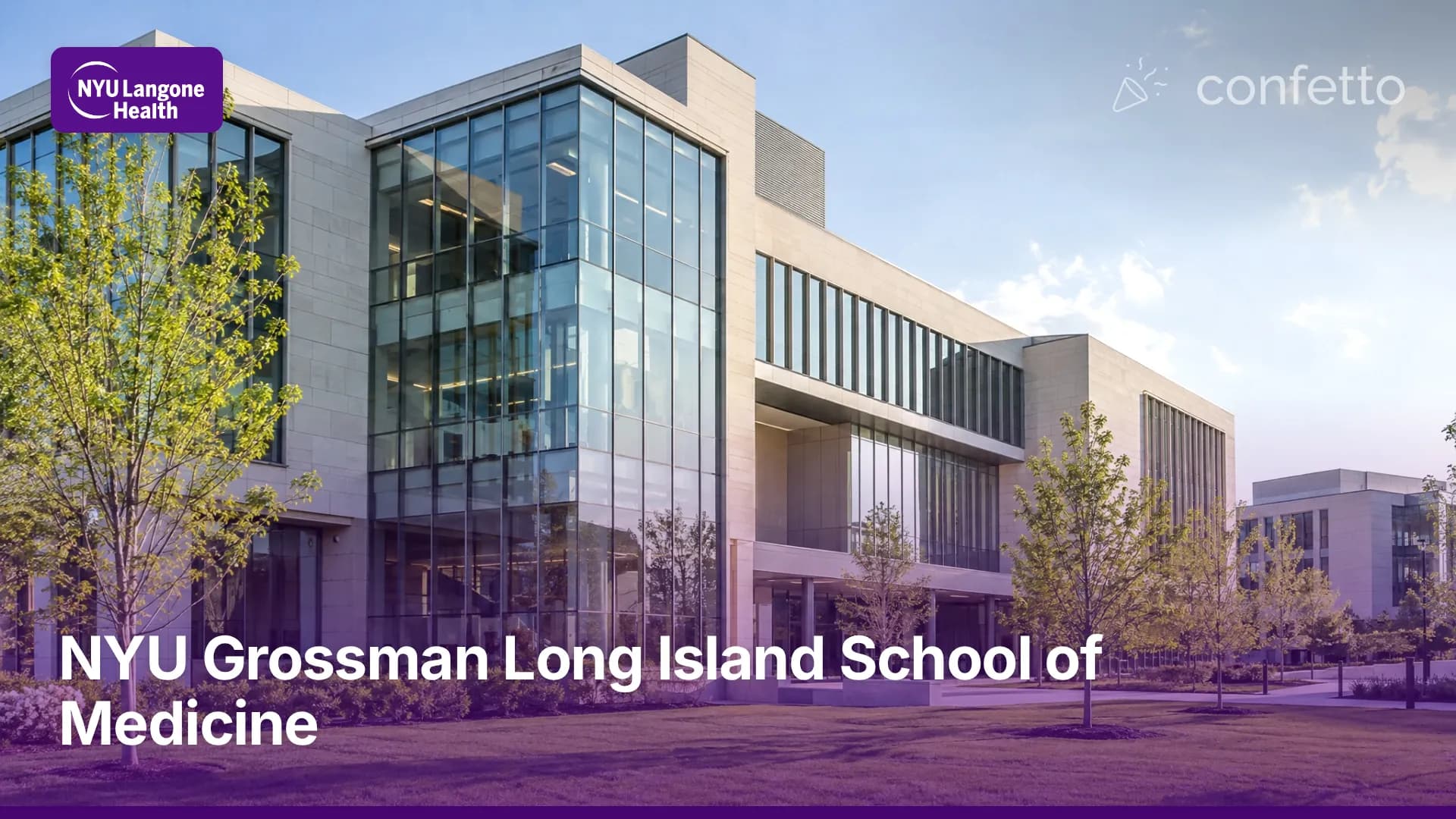
This guide covers the MD interview at NYU Grossman Long Island School of Medicine in Mineola, New York.
If you applied to the Manhattan campus, read our separate guide for NYU Grossman School of Medicine.
Mineola's admissions team uses a virtual two-part interview built around core personal attributes, primary care readiness, and teamwork.
Part one is a Multiple Mini-Interview circuit of short conversations with different assessors at separate stations, lasting about an hour.
Part two is an interactive group activity facilitated by NYU Langone Hospital, Long Island Simulation Center staff, also lasting about an hour.
On interview day, you divide into two concurrent groups so one cohort completes the MMI while the other completes the team exercise.
When those concurrent sessions end, the two groups switch places so every applicant finishes both parts.
For context, the Association of American Medical Colleges notes that a typical medical school MMI takes nearly two hours across six to 10 stations.
Standard MMIs usually pair a two-minute prep period with a five-to-eight-minute conversation.
According to the Association of Faculties of Medicine of Canada, McMaster University introduced the MMI in 2004 using stations of eight minutes or less.
NYU Grossman Long Island condenses its MMI circuit to about an hour and pairs it with a dedicated team simulation.
All interviews take place virtually from September through early December, and you receive schedule details before your interview day.
| Component | Official structure |
|---|---|
| Overall format | Two-part virtual assessment: an MMI circuit plus an interactive group activity |
| Duration | About an hour for the MMI circuit and about an hour for the group activity |
| Day flow | Applicants split into two concurrent groups and switch activities halfway through |
| MMI station types | Scenario conversations, a nonclinical standardized patient station, and a limited application station |
| Group facilitators | NYU Langone Hospital, Long Island Simulation Center staff |
| Interview season | Invitations begin in August 2026, with virtual interviews from September through early December |
Inside each MMI station and the Simulation Center group activity
Your virtual interview day tests you across four distinct settings rather than one repetitive question style.
Because different assessors score separate MMI stations independently, a rough moment in one room stays behind you when you rotate.
- Scenario-based MMI stations: You rotate through short scenario discussions mapped to the interpersonal and intrapersonal AAMC Core Competencies for Entering Medical Students. Assessors evaluate your decision-making, critical-thinking, and communication skills, so explain how you weigh competing priorities out loud.
- Nonclinical standardized patient station: One station observes you in a nonclinical interaction with a standardized patient. MMIs do not test specialized medical knowledge, so focus on steady camera eye contact, plain language, and active listening.
- Limited traditional interview station: One MMI station asks specific questions about your application. Re-read your AMCAS file and secondary essays covering your residency track, path to medicine, obstacles faced, and community ties.
- Simulation Center interactive group activity: Simulation Center staff facilitate a team-based exercise lasting about an hour. In medical school group interviews, cohorts receive a shared problem and a set time to solve it while raters assess collaboration.
What assessors look for: Core competencies and primary care readiness
Admissions reviewers seek passion for primary care, direct clinical experience in your chosen residency track, and a goal of generalist practice.
They also evaluate academic readiness for the accelerated three-year curriculum, a team-based mindset, maturity, and commitment to local communities.
Because the curriculum centers on health systems science, the school looks for future change-agents in comprehensive, equitable, value-based care.
These goals align with the 2024 Foundational Competencies for Undergraduate Medical Education co-produced by the AAMC, the American Association of Colleges of Osteopathic Medicine, and the ACGME.
That national framework sets six core competencies and 45 subcompetencies for all medical students, and three domains fit your interview stations directly.
- Professionalism: Subcompetencies cover safeguarding privacy, confidentiality, and autonomy, ethical reasoning, owning mistakes, and recognizing personal limits. Name your ethical duty clearly and show humility toward people from different backgrounds.
- Interpersonal and Communication Skills and Patient Care: Subcompetencies emphasize integrating patient and caregiver context, values, and preferences while using patient-centered language. Ask open questions first and confirm understanding before suggesting practical steps.
- Systems-Based Practice and Practice-Based Learning: Subcompetencies include social and structural determinants of health, safe care transitions across hospital and clinic settings, and using feedback. Mentioning outpatient follow-up and interprofessional teamwork highlights readiness for health systems science.
Mission fit: Three-year MD, residency tracks, and Mineola training
Strong answers in the limited application station connect your clinical background to how this campus trains physicians.
The entering class is currently capped at 24 students, fostering close daily collaboration with classmates and faculty.
Training takes place in Mineola in Nassau County, 17 miles outside New York City, across from the 591-bed NYU Langone Hospital, Long Island.
You also train in community outpatient practices across all three years, and you need a car for most outpatient sites.
Students serve uninsured neighbors at the WiSH Free Health Clinic and mentor local youth through the Envision Scholars Program.
Campus organizations include internal medicine, pediatrics, obstetrics and gynecology, and family medicine interest groups alongside the Medical Ethics Society and Medical Spanish Club.
If you are interviewing across Long Island, you can also review our guide for the Zucker School of Medicine at Hofstra/Northwell.
On the secondary application, you select one directed primary care residency pathway: internal medicine, pediatrics, or obstetrics and gynecology.
Upon acceptance, you learn you will be ranked to match into that residency at NYU Langone Hospital, Long Island through the NRMP.
Keeping that position requires satisfactory academic progress and professional standards, though you may also rank external primary care programs.
If you want family medicine, you apply via the internal medicine track, work with family medicine mentors, and can match externally.
The three-year accelerated curriculum shortens medical school by one full year and includes two- and four-week electives aligned with your track.
The school offers no dual degrees or leaves of absence for subspecialty portfolios, and subspecialty-focused applicants should apply elsewhere.
Extracurricular research spans quality improvement, population health, health services, and clinical or translational projects, supported by twice-yearly research workshops.
How to discuss the Full-Tuition Scholarship and accelerated timeline
Show details
All enrolled MD students receive three-year Full-Tuition Scholarships regardless of merit or financial need while maintaining academic progress and professionalism.
U.S. citizens, permanent residents, DACA recipients, and international students holding an accredited U.S. or Canadian bachelor's degree all qualify.
For the 2026-27 academic year, annual tuition is $63,552, offset by a $63,552 Full-Tuition Scholarship.
Every student also enrolls in the mandatory $9,325 Student Health Insurance Plan, covered by a $9,325 school subsidy.
By our calculation from the 2026-27 Cost of Attendance table, those two awards cover $72,877 yearly, or $218,631 over three years.
Students still budget for $4,550 in mandatory annual fees plus housing, food, books, miscellaneous living expenses, and second-year USMLE fees.
Remaining estimated costs are $32,396 in year one over 12 months, $32,080 in year two over 11 months, and $30,430 in year three over 11 months.
By our calculation from the same table, remaining estimated expenses total $94,906 across all three years.
Qualifying students submit the CSS Profile annually for need-based Debt-Free Scholarships, while eligible students may seek federal loans via the FAFSA.
When discussing the scholarship or three-year pace, focus on entering generalist primary care one year earlier to serve communities rather than personal finances.
Interview timeline and key admissions policies
Show details
Completing the secondary application requires a nonrefundable $110 fee, which is waived for AAMC Fee Assistance Program recipients.
For July 2027 matriculation, MCAT scores must date from January 2024 or later, with no exceptions.
You must submit a prehealth committee letter or at least three individual letters including two from science professors, up to 10 letters maximum via AMCAS.
Rather than rolling fall acceptances, NYU Grossman Long Island releases all MD admissions decisions in February 2027.
Admitted applicants must accept in the online portal within two weeks on or before April 30, or the offer is rescinded.
That response window shortens to five business days between May 1 and June 15, and two business days on or after June 15.
| Date | Milestone |
|---|---|
| August 2026 | NYU Grossman Long Island begins sending interview invitations |
| Early September 2026 | Virtual Multiple Mini-Interviews and group sessions begin |
| October 1, 2026 | FAFSA and CSS Profile applications open |
| November 1, 2026 | AMCAS primary application deadline |
| November 16, 2026 | Secondary application due at 11:59 p.m. ET with $110 fee |
| December 2026 | Virtual Multiple Mini-Interviews conclude |
| February 2027 | All MD applicants receive admissions decisions |
| February 23, 2027 | Plan to Enroll opens in the AMCAS Choose Your Medical School tool |
| April 1, 2027 | Waitlist offers begin and FAFSA, CSS Profile, and deferral deadlines close |
| April 15, 2027 | Accepted applicants may hold no more than three acceptances in AMCAS |
| April 30, 2027 | Commit to Enroll option opens in AMCAS |
| May to June 2027 | Registration, health forms, housing, and orientation details sent |
| June 1, 2027 | Mandatory Commit to Enroll deadline in AMCAS |
| July 5, 2027 | Transition to Medical School program begins |
Practice prompts written by our team
Our team wrote the prompts below to match NYU Grossman Long Island's four interview settings, primary care mission, and health systems focus.
Reviewing general MMI practice questions with answers first can help you organize ethical arguments before drilling primary care scenarios.
When practicing solo, use standard national MMI timing: two minutes to organize your thoughts and five minutes to speak.
- Application station: Walk me through the direct clinical experiences that led you to choose internal medicine, pediatrics, or obstetrics and gynecology.Practice a question like this
- Application station: Our three-year curriculum leaves little room to explore outside primary care. How have you tested your commitment to generalist practice?Practice a question like this
- Application station: Tell me about an obstacle on your path to medicine and how it shaped the way you work on teams.Practice a question like this
- Standardized patient role-play: Speak with an adult son who feels confused by his mother's hospital discharge instructions from yesterday.
- Standardized patient role-play: Meet with a volunteer coordinator after you missed a scheduled community clinic shift without notice.
- Health systems scenario: Many patients at an outpatient clinic miss hypertension follow-up visits. How could the care team investigate and respond?Practice a question like this
- Ethical scenario: A patient skips doses of a costly medication to afford groceries and asks you not to tell the physician. How do you respond?Practice a question like this
- Group simulation warm-up: Your group must award one community health grant, and two louder peers talk over a quieter teammate. How do you contribute?Practice a question like this
Step-by-step preparation plan and virtual day checklist
Show details
Strong MMI practice and preparation comes from speaking out loud under timed pressure rather than memorizing scripted essays.
Combining peer drills with AI mock interviews helps you answer unexpected follow-up questions naturally on camera.
Fold the five steps below into your medical school interview prep schedule during the two weeks before your virtual date.
- Step 1, Audit your application: Re-read your AMCAS activities and secondary essays so you can explain your residency track, clinical experiences, and community ties concisely.
- Step 2, Structure scenario reasoning: Practice naming the core tension, weighing each stakeholder's view, checking personal bias, and proposing an ethical next step.
- Step 3, Record nonclinical role-play: Practice responding on video to a worried friend so you can check camera eye contact, pacing, and plain language.
- Step 4, Build two-hour stamina: Rehearse an hour of MMI prompts alongside an hour-long group task in both orders so you are ready for either cohort.
- Step 5, Test your virtual setup: Verify a stable connection, clear microphone, quiet room, professional background, and login instructions from your admissions email.
Practice question
Why primary care, and why did you choose the residency track on your secondary application?
See an example answer
Example answer written by our team. The applicant is invented. I chose the internal medicine track on my secondary application because I want long-term relationships with adult primary care patients. Working in a community internal medicine clinic showed me how much patient health depends on what happens between appointments. A patient can understand a treatment plan in the exam room and still struggle with prescription refills or follow-up visits at home. Helping nurses and physicians coordinate outreach between visits taught me that generalist care relies on teamwork and health systems science. That direct outpatient experience tested my interest in adult primary care and confirmed that I want to practice as an internal medicine generalist. Because my career goal is settled now, the three-year accelerated MD and directed residency pathway at NYU Langone Hospital, Long Island fit me well. I am ready for the accelerated pace and excited to learn alongside peers in a collaborative 24-student class.
This answer works for the limited traditional application station because it connects the secondary residency track directly to hands-on outpatient experience. It also reflects qualities the school seeks: generalist primary care commitment, health systems science awareness, teamwork, and readiness for the three-year MD.
Frequently asked questions
What is the NYU Grossman Long Island MMI format?
NYU Grossman Long Island uses a virtual two-part interview with an MMI circuit and a team-based group activity, each lasting about an hour. The MMI includes scenario conversations mapped to AAMC core competencies, a nonclinical standardized patient station, and a limited application station. Applicants split into two cohorts and switch halfway through so everyone completes both parts.
Are NYU Grossman Long Island interviews virtual or in person?
All interviews at NYU Grossman Long Island School of Medicine take place virtually from September through early December. Invitations begin going out in August, and the admissions office sends schedule details before your interview day.
What happens during the NYU Grossman Long Island group activity?
You complete an interactive team-based exercise facilitated by NYU Langone Hospital, Long Island Simulation Center staff. This session takes about an hour and evaluates your teamwork and collaboration skills alongside other applicants.
How do residency tracks connect to the NYU Long Island interview?
On the secondary application, you choose a directed residency pathway in internal medicine, pediatrics, or obstetrics and gynecology at NYU Langone Hospital, Long Island. Reviewers evaluate your direct clinical experiences in that field, and one MMI station asks specific questions about your application. Candidates interested in family medicine apply through the internal medicine track.
When does NYU Grossman Long Island release admissions decisions?
After virtual interviews conclude in December 2026, NYU Grossman Long Island notifies all MD applicants of admissions decisions in February 2027. Waitlist acceptances begin on April 1, 2027, and mandatory Commit to Enroll closes on June 1, 2027.
Does every NYU Grossman Long Island student receive free tuition?
Yes, all enrolled MD students receive a three-year Full-Tuition Scholarship worth $63,552 per year for 2026-27 regardless of merit or financial need. Students must maintain satisfactory academic progress and professionalism standards to keep the award. The school also provides a $9,325 health insurance subsidy and offers need-based Debt-Free Scholarships for living and educational costs.
Sources
- NYU Grossman Long Island MD Admissions Interview Process
- NYU Grossman Long Island MD Admissions
- NYU Grossman Long Island MD Admissions Commonly Asked Questions
- NYU Grossman Long Island How to Apply to the MD Program
- NYU Grossman Long Island MD Admissions Deadlines and Policies
- NYU Grossman Long Island MD Admissions Requirements
- NYU Grossman Long Island Financial Aid for MD Students
- NYU Grossman Long Island Cost of Attendance
- AAMC Preparing for Your Medical School Interview
- AAMC What It Is Like to Participate in Multiple Mini Interviews
- AAMC, AACOM, and ACGME Foundational Competencies for Undergraduate Medical Education
- AFMC Admission Requirements of Canadian Faculties of Medicine
NYU Long Island admissions: MCAT, GPA, prerequisites and deadlines
Every line below links its source: NYU Long Island's own pages and the AAMC's public FACTS tables, checked November 2026. Confirm dates in the school's portal before you submit.
| What | Detail and source |
|---|---|
| Entering class | Capped at 24 students. The MD takes three years, and every enrolled student gets a full-tuition scholarship while making satisfactory progress. Source: NYU Long Island: MD admissions commonly asked questions, NYU Long Island: MD admissions |
| AAMC applications and new students | 4,738 applications and 24 new students for fall 2025 entry, about 0.5 new students per 100 applications. Source: AAMC FACTS Table A-1 (2025-2026) |
| Mission and residency track | Primary care only. On the secondary you pick internal medicine, pediatrics or obstetrics and gynecology, and accepted students are ranked to match into that residency at NYU Langone Hospital, Long Island, if they rank it. Source: NYU Long Island: MD admissions, NYU Long Island: How to apply |
| MCAT | Required. For July 2027 entry the oldest accepted score is from January 2024, with no exceptions. The school's pages don't mention an average or minimum MCAT or GPA. Source: NYU Long Island: Admissions requirements |
| Prerequisites | None mandated. The school expects strong preparation in biology, physics, chemistry, genetics, statistics, English, psychology and sociology, and strongly recommends those courses. Source: NYU Long Island: Admissions requirements |
| Casper and PREview | NYU Long Island's admissions pages don't mention Casper or PREview as of November 2026. They name the MCAT as the required exam. Source: NYU Long Island: Admissions requirements |
4 more NYU Long Island admissions factsDeadlines (2027 entry), Secondary, Letters, Who can apply
| What | Detail and source |
|---|---|
| Deadlines (2027 entry) | AMCAS closed November 1, 2026. The secondary is due November 16, 2026 at 11:59 p.m. ET. Interview invitations from August 2026, interviews from early September through December 2026, and decisions in February 2027. Source: NYU Long Island: Admissions deadlines and policies, NYU Long Island: How to apply |
| Secondary | Emailed after AMCAS sends your completed primary. Fee $110, waived with AAMC Fee Assistance. It asks for your residency track and why, your path to medicine and obstacles, and ties to the communities the school serves. Source: NYU Long Island: How to apply |
| Letters | A committee or composite letter, or at least three individual letters with two from science professors. Up to 10 letters, through the AMCAS Letter Service only. Source: NYU Long Island: Admissions requirements |
| Who can apply | US citizens, permanent residents, DACA recipients and international applicants, all with a bachelor's degree from a US or Canadian school by the time they start. Source: NYU Long Island: How to apply |
Not published on NYU Long Island's site as of November 2026: acceptance rate or number of acceptances, number of applicants interviewed, average or median MCAT and GPA of the entering class, a minimum MCAT or GPA, the secondary essay prompts word for word.
NYU Long Island secondary application
NYU Long Island doesn't post its exact secondary prompts as of November 2026, but its How to Apply page says what they cover. You name the primary care residency track you want (internal medicine, pediatrics or obstetrics and gynecology) and say why, describe your path to medicine and any obstacles, and note any ties to the communities the school serves.
The secondary is due November 16, 2026 at 11:59 p.m. ET, and the fee is $110. The school urges you to finish it early so your file is reviewed in time for an interview.
How secondaries work and the common prompt types: medical school secondary essays. Real prompts from other schools with outlines: secondary essay examples. Confetto's Essay Coach reviews personal statements and secondaries and gives you a score and notes on your exact lines. Try Essay Coach.
NYU Long Island admissions FAQ
What is the NYU Grossman Long Island acceptance rate?
The school doesn't publish an acceptance rate as of November 2026. AAMC data for 2025-26 shows 4,738 applications and 24 new students, about 0.5 new students per 100 applications. The share offered a seat is a little higher, since some admitted applicants go elsewhere.
Does NYU Long Island require Casper or PREview?
Its admissions pages don't mention Casper or PREview as of November 2026. The MCAT is required, and for July 2027 entry the oldest accepted score is from January 2024.
Does NYU Long Island have prerequisites?
No courses are mandated. The school expects strong preparation in biology, physics, chemistry, genetics, statistics, English, psychology and sociology, and strongly recommends those courses.
Checked November 2026 against NYU Long Island: MD admissions commonly asked questions, NYU Long Island: MD admissions, AAMC FACTS Table A-1 (2025-2026), NYU Long Island: How to apply, NYU Long Island: Admissions requirements and NYU Long Island: Admissions deadlines and policies.
More on NYU Long Island
Admissions numbers: NYU Long Island acceptance rate and stats