
Updated · 6 min read
Valley College of Osteopathic Medicine Interview Guide
Key facts (2026-27)
Interview Day is in person in Phoenix and mandatory for admission. AACOM lists an MMI, and The Valley COM has not published how many stations or how long each lasts.
- Format
- In-person MMI (multiple mini interviews)
- Where
- In person
- Interview dates
- Rolling from early fall 2026, exact dates not published
Checked October 2026 against AACOM Choose DO: The Valley COM and The Valley COM: How to apply. Confirm details in your invitation.
The Valley COM admissions in brief
The Valley COM in Phoenix doesn't publish an acceptance rate or class MCAT and GPA as of November 2026. It lists a target class size of 180 and holds COCA pre-accreditation. You need a 2.8 cumulative and science GPA and an MCAT above 497 to be considered for an interview. There's no secondary, and its pages don't mention Casper or PREview. AACOMAS closes April 1, 2027, but the school recommends applying by January 15, 2027.
The Valley College of Osteopathic Medicine (The Valley COM) interviews applicants in person in Phoenix using a Multiple Mini Interview (MMI). To qualify for an interview, the college requires an MCAT score greater than 497 and a 2.8 cumulative and science GPA. AACOM confirms no supplemental application is required, and rolling post-interview decisions arrive within 4 to 6 weeks. Sources: The Valley COM: How to Apply, The Valley COM: Admission Requirements, The Valley COM: Mission and Vision. Last checked November 18, 2026.
The Valley COM Interview Format and Day Structure
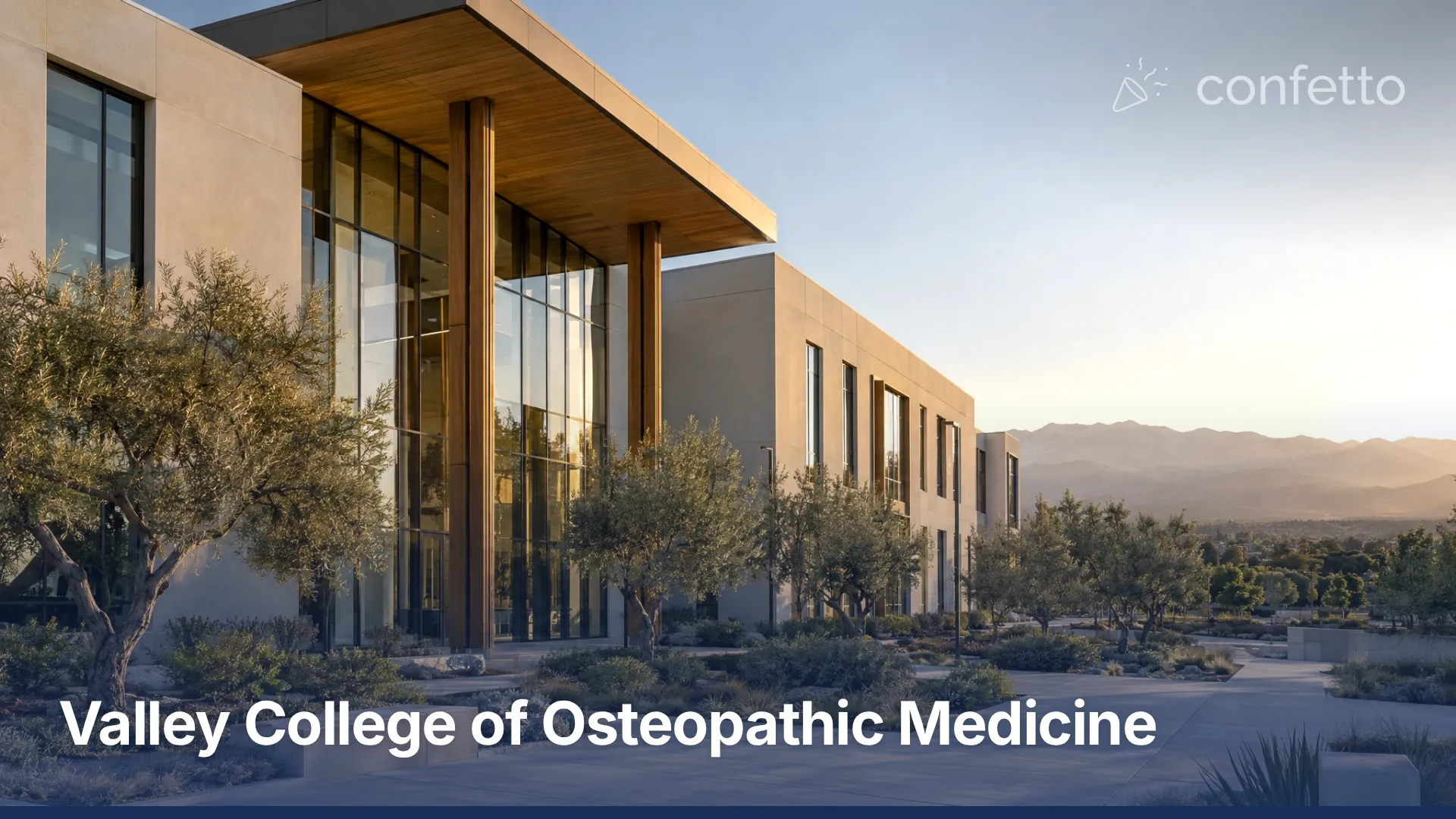
The Valley COM invites selected candidates to its gated 11-acre urban campus at 2525 W. Townley Ave in Phoenix, Arizona. According to The Valley COM How to Apply page, your visit pairs faculty and staff MMI stations with a campus tour and information session.
AACOM's Choose DO Explorer profile lists in-person interviews only, with no virtual interview option. Attendance at Interview Day is mandatory for admission and serves as a two-way evaluation for both you and the Admissions Committee.
During your tour, you will walk a four-story facility designed around active training. Floor two holds classrooms and team-based case rooms, while floor three houses the osteopathic manipulative medicine (OMM) lab, virtual reality lab, and simulation spaces.
Your invitation email will confirm your check-in schedule and station rules. For general pacing, the AAMC notes that medical school MMIs typically run nearly two hours across 6 to 10 stations.
In that standard model, you receive two minutes to prepare outside each room followed by a five- to eight-minute conversation. In-person MMI circuits often blend ethical scenarios, standardized patient interactions, teamwork tasks, and one-on-one faculty stations.
| Feature | Official Policy |
|---|---|
| Interview structure | Multiple Mini Interview (MMI) with faculty and staff |
| Delivery mode | In-person only at 2525 W. Townley Ave, Phoenix, AZ 85021 |
| Interview Day extras | Guided campus tour, information session, and cultural immersion |
| Secondary application | No supplemental application required |
| Minimum MCAT for interview | Greater than 497 (taken within 3 years) |
| Minimum GPA | 2.8 cumulative GPA and 2.8 science GPA |
| Decision turnaround | 4 to 6 weeks after Interview Day (rolling) |
What The Valley COM Evaluates in Your MMI
Every MMI circuit reflects the host school's mission. On its Mission and Vision page, The Valley COM commits to training osteopathic physicians with the courage to lead, the passion to serve, and a devotion to learning.
Its vision emphasizes meeting the healthcare needs of underserved areas across Arizona. Two mottos appear across official college materials: Courage to Lead. Passion to Serve. and Care. Lead. Succeed.
Beyond grades and test scores, the Admissions Committee conducts a holistic review of your healthcare exposure, volunteer service, research, and leadership. On Interview Day, raters score interpersonal and non-cognitive qualities that transcripts cannot measure.
The college's Technical Standards also require clear English communication with patients and healthcare teams, time-sensitive reasoning, and professional team-based behavior. Keep those clinical habits visible in how you listen and respond at every station.
| Attribute Named by the School | How to Show It in an MMI Station |
|---|---|
| Compassion and whole-person care | Acknowledge a person's fear, cost barrier, or living situation before proposing a plan |
| Communication skills | State your main point first, use plain language, and check that the other person feels heard |
| Teamwork and leadership | Invite quieter voices in group tasks and center disagreements on shared patient goals |
| Professionalism and integrity | Address mistakes or safety shortcuts directly without hiding errors or blaming peers |
| Resilience and lifelong learning | Explain how critical feedback changed your habits rather than making excuses |
| Commitment to underserved communities | Discuss Arizona access gaps with humility and ask what local communities need |
Curriculum and Campus Facts to Know Before Interview Day
Founded in 2023 as a private, for-profit osteopathic medical school, The Valley COM holds Pre-Accreditation Status from the Commission on Osteopathic College Accreditation (COCA). Its homepage highlights its 2026 inaugural class and its 2024 to 2027 Strategic Plan.
Expect stations or tour conversations to explore why an active, case-based model fits how you learn. The Valley COM teaches through its four-year PICASO framework, short for Patient Informed Case Based Osteopathic Education.
Because there is no on-campus housing, accepted students receive a curated local rental list and access to a roommate SharePoint group. Student wellness spaces on the first floor include study lounges and a fitness center with showers.
Since Interview Day is a two-way evaluation, bring specific questions for the information session. Strong topics include small-group case preparation in Years 1 and 2, clinical rotation sites across Arizona, and faculty mentoring.
- Years 1 and 2: Clinical presentation model integrating small-group case discussions, experiential labs, and self-directed study time.
- Hands-on labs: High-fidelity mannikin simulation, virtual and augmented reality anatomy, standardized patients, OMM palpation labs, and Lifestyle Medicine cases.
- Years 3 and 4: Clinical rotations paired with weekly synchronous virtual didactic learning.
- Research requirement: Longitudinal research coursework across the curriculum ending in a mandatory capstone project.
- The COMPass Program: Engaged advising, coaching, residency readiness, and structured COMLEX Level 1 and Level 2 preparation.
How to Prepare: A 7-Day Plan and 40-Minute MMI Circuit
An MMI rewards structured thinking aloud under a strict clock, not memorized speeches. Our medical school interview prep guide breaks down core station frameworks you can adapt to Arizona healthcare themes.
During your two-minute pause outside a room, name the core tension, list who is affected, and pick a practical first step.
When practicing solo, you can run timed stations using AI mock interviews to check your pacing and clarity. Pair solo drills with at least one live session with a peer or advisor before flying or driving to Phoenix.
- Days 1 to 2: Study The Valley COM mission, PICASO case learning, COMPass coaching, and osteopathic whole-person care.
- Days 3 to 4: Practice ethical and policy prompts aloud using a two-minute prep timer and a five-minute speaking cap.
- Day 5: Rehearse role-play stations where an upset patient, classmate, or family member pushes back on your initial idea.
- Day 7: Trim rambling introductions, pack professional attire for Phoenix, and write three specific questions for the campus Q&A.
Practice MMI Prompts Written by Our Team
Our team wrote these practice prompts around The Valley COM's mission, technical standards, and case-based learning rooms. They are study scenarios created by our team, not official prompts from the college.
Use two minutes of silent planning and five minutes of speaking on each prompt. For broader ethical, teamwork, and communication drills, try our free question bank preview.
- A Phoenix clinic patient tells you they skip blood pressure pills because summer electric bills took their pharmacy budget. How do you handle the visit?Practice a question like this
- In a small-group PICASO session, one classmate talks over quieter peers and rushes past physiology questions. What do you do in the moment?Practice a question like this
- At a rural Arizona clinic rotation, a patient asks why they should open up to a student leaving in four weeks. What do you say?Practice a question like this
- In the OMM lab, your partner looks uncomfortable during a palpation drill but stays quiet to avoid seeming difficult. How do you check in?Practice a question like this
- You spot a classmate copying last week's simulation room checklist instead of verifying equipment before a group run. Walk through your next steps.Practice a question like this
- Why are you choosing osteopathic medicine, and why does a newer, pre-accredited program like The Valley COM match your learning style?Practice a question like this
- Extreme desert heat affects outdoor workers, unhoused neighbors, and older adults on fixed incomes differently. How can a physician help one group beyond clinic walls?Practice a question like this
- The college motto is Courage to Lead. Passion to Serve. Share a time when serving someone well required you to speak up despite discomfort.
Application Timeline and Seat Deposit Rules
Show details
The Valley COM runs rolling admissions with no Early Decision Program and no secondary application. Interviews begin in early fall, so applying early on AACOMAS gives you the best shot while seats remain open.
Accepted applicants follow the AACOMAS Traffic Guidelines schedule for deposit windows. By our calculation from AACOM's Choose DO Explorer profile, the $2,500 acceptance deposit and $1,500 additional deposit total $4,000 in non-refundable deposits applied toward tuition.
- May 4, 2026: Earliest date to submit your primary AACOMAS application.
- Early Fall 2026: On-campus MMI Interview Days begin in Phoenix on a rolling basis.
- January 15, 2027: Recommended AACOMAS submission date for strongest consideration.
- March 1, 2027: Latest MCAT exam date accepted (oldest score considered is May 4, 2023).
- April 1, 2027: Final primary AACOMAS deadline (submit at least four weeks prior).
- July 19, 2027: Mandatory first-year orientation and start date.
| Acceptance Date Window | Time Allowed to Submit Deposit |
|---|---|
| Prior to November 15 | Until December 14 |
| November 15 through January 14 | 30 days from acceptance |
| January 15 through April 30 | 14 days from acceptance |
| On or after May 1 | May be asked for an immediate deposit |
Admissions Cutoffs, Prerequisites, and Eligibility Rules
Show details
On its Admissions Overview page, The Valley COM requires applicants to be U.S. citizens or permanent residents with a bachelor's degree prior to matriculation. You must not have previously matriculated into a DO or MD program.
International and DACA applicants are not eligible, and MCAT waivers are not granted. Formal shadowing is not required, while two recommendation letters via AACOMAS are needed, including a required MD or DO physician letter.
All 44 prerequisite semester hours require a grade of C or better at a regionally accredited institution. Online courses and online science labs are accepted, but Pass/Fail grades are not accepted for prerequisites.
If you are also interviewing at nearby osteopathic programs, compare formats in our guides for Midwestern University Arizona, A.T. Still University SOMA, and our Touro University Nevada interview guide. You can also book weekday Phoenix campus tours Monday through Friday from 8:00 AM to 4:00 PM.
| Subject Area | Minimum Credits | Course and Lab Notes |
|---|---|---|
| Biology with Lab | 8 semester hours | Includes cellular or molecular biology, online labs accepted |
| General Chemistry with Lab | 8 semester hours | Includes inorganic chemistry, online labs accepted |
| Organic Chemistry with Lab | 8 semester hours | Grade of C or better required, no Pass/Fail grades |
| Physics with Lab | 8 semester hours | Grade of C or better required, online labs accepted |
| English or Writing | 6 semester hours | Composition and/or literature |
| Behavioral Sciences | 6 semester hours | Psychology and/or sociology |
Tuition, Cost of Attendance, and Private Loan Financing
Show details
Review loan options carefully before paying a non-refundable deposit. On its Financial Aid and Scholarships page, The Valley COM states that students needing financial assistance must seek credit-based private educational loans, which may require a creditworthy cosigner.
The college offers FastChoice by ScholarNet to compare private lenders and highlights external awards like NHSC, Armed Forces HPSP, VA HPSP, and Indian Health Service scholarships. Institutional scholarships are not offered.
Official pages list equal in-state and out-of-state rates across two published schedules. The Financial Aid page estimates $55,500 in annual tuition ($27,750 per semester, due on the first day of class) inside a $100,231 annual Cost of Attendance.
By our calculation from The Valley COM Financial Aid table, four years at $100,231 per year equals $400,924 before loan interest or annual adjustments.
| Expense Category | Fall | Spring | Annual Estimate |
|---|---|---|---|
| Tuition | $27,750 | $27,750 | $55,500 |
| Fees and Registration | $2,930 | $0 | $2,930 |
| Health Insurance (can be waived) | $4,851 | Not published | $4,851 |
| Housing | $13,075 | $13,075 | $26,150 |
| Transportation, Personal, and Equipment | $5,600 | $5,200 | $10,800 |
| Combined Cost of Attendance | $54,206 | $46,025 | $100,231 |
Practice question
During a second-year small-group PICASO case discussion, a teammate dismisses a patient's housing instability and lack of air conditioning in Phoenix as social worker business so the group can focus strictly on pharmacology. How do you respond in the room?
See an example answer
Example answer written by our team. The applicant is invented. I would respond calmly right there without shaming my classmate, because team trust and whole-person reasoning both matter in a case-based room. First, I would affirm their goal of getting the pharmacology right, since safe prescribing is essential. Next, I would tie the patient's housing situation directly back to drug safety so the team sees they cannot be separated. Without reliable cooling in a Phoenix summer, certain medications degrade in high heat, and diuretics raise dehydration risk when water access is unstable. I would ask our group how our first-line prescription changes if this patient sleeps outdoors or rations utility bills. After we map out both safe prescribing and clinic social support referrals, I would check in briefly with my teammate after class. Supporting peers while advocating for the whole patient helps the entire group think like osteopathic physicians.
It avoids embarrassing the peer, links Phoenix heat and housing directly to safe pharmacology, and reflects The Valley COM's team-based PICASO format and whole-person mission.
Frequently asked questions
What is The Valley College of Osteopathic Medicine?
The Valley College of Osteopathic Medicine (The Valley COM) is a private, for-profit osteopathic medical school founded in 2023 at 2525 W. Townley Ave in Phoenix, Arizona. It holds Pre-Accreditation Status from COCA and trains future DOs through its four-year case-based PICASO curriculum.
What format is The Valley COM interview?
The Valley COM conducts a mandatory, in-person Multiple Mini Interview (MMI) on its Phoenix campus with faculty and staff. Your Interview Day includes a guided campus tour and information session, with no virtual option offered.
Does The Valley College of Osteopathic Medicine require a secondary application?
No, The Valley COM does not require a supplemental application. Applicants are screened for MMI invitations directly from their verified AACOMAS file, MCAT score report, and recommendation letters.
What GPA and MCAT score do you need for a Valley COM interview?
You need at least a 2.8 cumulative GPA, a 2.8 science GPA, and an MCAT score greater than 497 taken within three years. You must also finish 44 semester hours of required prerequisites with a grade of C or better, without Pass/Fail grading.
How long after The Valley COM interview do decisions come out?
The Valley COM uses rolling admissions and sends accept, waitlist, or denial decisions within 4 to 6 weeks after Interview Day.
How do students finance tuition at The Valley COM?
The school's Financial Aid page estimates annual Cost of Attendance at $100,231, while AACOM lists annual tuition at $57,450. Because institutional scholarships are not offered, students needing loans use credit-based private lenders via FastChoice or apply for external HPSP and NHSC scholarships.
Sources
- The Valley COM: How to Apply
- The Valley COM: Admission Requirements
- The Valley COM: Mission and Vision
- The Valley COM: Admissions Overview
- The Valley COM: Financial Aid and Scholarships
- The Valley COM: Technical Standards
- The Valley College of Osteopathic Medicine Homepage
- AACOM Choose DO Explorer: The Valley College of Osteopathic Medicine
- AAMC: What It's Like to Participate in Multiple Mini Interviews (MMIs)
The Valley COM admissions: MCAT, GPA, prerequisites and deadlines
Every line below links its source: The Valley COM's own pages and AACOM's public pages, checked November 2026. Confirm dates in the school's portal before you submit.
| What | Detail and source |
|---|---|
| Entering class | A target class size of 180. The Valley COM is pre-accredited by COCA, first granted in 2025. Its pages and AACOM profile don't give a count of enrolled students or class stats. Source: The Valley COM: Program information, The Valley COM: Accreditation |
| Minimum GPA and MCAT | A 2.8 cumulative GPA and a 2.8 science GPA. The requirements page says you need an MCAT above 497 to be considered for an interview (the admissions page lists 497 as the minimum), so aim above 497. Scores must be within three years, and AACOM lists May 4, 2023 to March 1, 2027 as the accepted test dates. Source: The Valley COM: Admission requirements, The Valley COM: Admissions, AACOM Choose DO: The Valley COM |
| Prerequisites | A bachelor's degree from a regionally accredited US school, or equivalent, before you start, plus 44 semester hours with a C or better: 8 hours each of biology, general chemistry, organic chemistry and physics, all with lab, 6 of English or writing and 6 of behavioral sciences. Labs may be online, but AACOM says pass/fail grades don't count. Source: The Valley COM: Admission requirements, AACOM Choose DO: The Valley COM |
| Casper and PREview | The Valley COM's admissions pages and its AACOM profile don't mention Casper or PREview as of November 2026. Source: The Valley COM: Admissions, The Valley COM: Admission requirements, AACOM Choose DO: The Valley COM |
| Deadlines (2027 entry) | AACOMAS opened May 4, 2026 and closes April 1, 2027. The school highly recommends applying by January 15, 2027, since admissions are rolling. Interviews began in early fall 2026 and continue on a rolling basis, and orientation is July 19, 2027. Source: AACOM Choose DO: The Valley COM |
| Secondary | None. AACOM's profile says no supplemental application is required, so your AACOMAS application, letters and official MCAT score report make up the file. Source: AACOM Choose DO: The Valley COM |
3 more The Valley COM admissions factsInterviews and decisions, Letters, Who can apply
| What | Detail and source |
|---|---|
| Interviews and decisions | On campus in Phoenix and in person only, in Multiple Mini Interview (MMI) format with a campus tour and information session. Interview Day is mandatory for admission. Decisions come 4 to 6 weeks after your interview day: accept, waitlist or deny. Source: The Valley COM: How to apply, AACOM Choose DO: The Valley COM |
| Letters | The school's page asks for 2 letters of recommendation through AACOMAS. AACOM's profile marks a physician letter (MD or DO) as required, so plan for one of the two to come from a physician. Source: The Valley COM: How to apply, AACOM Choose DO: The Valley COM |
| Who can apply | US citizens and permanent residents only, so no international or DACA applicants, and nobody who has already matriculated into a DO or MD program. Students who need aid borrow through private lenders, according to the financial aid page. Source: The Valley COM: Admissions, AACOM Choose DO: The Valley COM, The Valley COM: Financial aid and scholarships |
Not published on The Valley COM's site as of November 2026: acceptance rate or numbers of applications, interviews or acceptances, average MCAT or GPA of enrolled students, the number of students enrolled so far, the number of MMI stations or their length.
The Valley COM secondary application (2027 entry)
The Valley COM has no secondary. AACOM's profile says a supplemental application isn't required, and a complete file is your AACOMAS application, the required letters and an official MCAT score report. Applicants who pass the initial screening are invited to Interview Day.
Because admissions are rolling, apply early. The school recommends submitting at least four weeks before the deadline and no later than January 15, 2027, even though AACOMAS stays open until April 1, 2027.
How secondaries work and the common prompt types: medical school secondary essays. Real prompts from other schools with outlines: secondary essay examples. Confetto's Essay Coach reviews personal statements and secondaries and gives you a score and notes on your exact lines. Try Essay Coach.
The Valley COM admissions FAQ
What is The Valley COM acceptance rate?
The Valley COM doesn't publish an acceptance rate or application numbers as of November 2026, and AACOM's profile has no class data for it yet. The school lists a target class size of 180.
What GPA and MCAT do you need for The Valley COM?
At least a 2.8 cumulative and science GPA, and an MCAT above 497 to be considered for an interview, taken within three years. The school doesn't publish the averages of the students it admits.
Does The Valley COM require Casper?
The Valley COM's admissions pages and its AACOM profile don't mention Casper or PREview as of November 2026. The interview is an in-person MMI on its Phoenix campus.
Does The Valley COM have a secondary application?
No. AACOM's profile says no supplemental application is required. After your AACOMAS application, letters and MCAT score are in, selected applicants are invited to an in-person Interview Day.
Checked November 2026 against The Valley COM: Program information, The Valley COM: Accreditation, The Valley COM: Admission requirements, The Valley COM: Admissions, AACOM Choose DO: The Valley COM, The Valley COM: How to apply and The Valley COM: Financial aid and scholarships.